IELTS 4.0 基础使用者 · Unit 3 Our digital lives · 文章精读
Smart life in the future 未来的智慧生活(播客访谈 · 说明文)
原文精读 · 词汇词组 · 语法和从句分析 · Grammar(比较级最高级)· Speaking(句子重音)
名词/冠词/代词/数字
动词
不定式
动名词
现在分词
形容词
副词
介词
连词
引导词 that
引导词 when/as
一、原文精读
1HostOur guest today is Dr Li, a technology expert.
今天的嘉宾是李博士,一位技术专家。
2Dr LiDr Li has studied how the internet will further change our lives in the future.
李博士研究过互联网在未来将如何进一步改变我们的生活。
3Dr LiThat is right. The internet has brought big changes to everyday life.
没错。互联网已经给日常生活带来了巨大变化。
4For example, e-learning and mobile payment have changed the way we study and shop.
例如,在线学习和移动支付改变了我们学习和购物的方式。
5In the future, even more things will be connected to the internet, so life will continue to change.
未来,将有更多事物连接到互联网,因此生活将继续改变。
6HostCan you give us some examples?
你能给我们举几个例子吗?
7Dr LiTake health for example.
以健康为例。
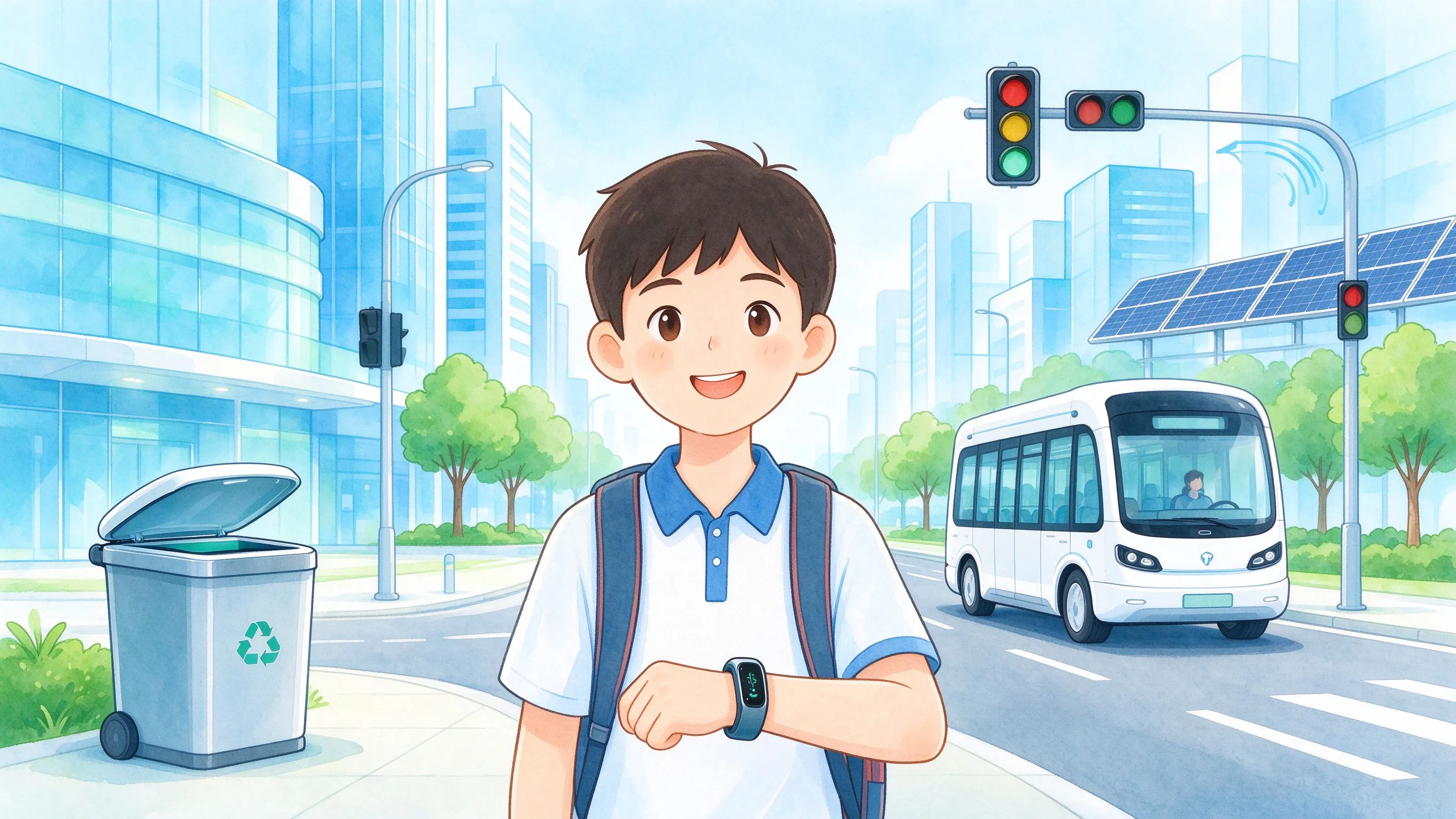
8We will probably wear small devices all the time, and they will check our health and warn us about health problems.
我们很可能会一直佩戴小型设备,它们会检查我们的健康状况,并就健康问题向我们发出预警。
9With this information, doctors can provide better treatment.
有了这些信息,医生就能提供更好的治疗。
10HostInteresting! Will the internet help improve the environment?
有意思!互联网会帮助改善环境吗?
11Dr LiYes! As more things become connected to the internet, our cities will become smart cities.
会的!随着更多事物连接到互联网,我们的城市将变成智慧城市。
12Smart cities will be more eco-friendly than cities today.
智慧城市将比今天的城市更环保。
13One of the most important changes will come in energy use.
最重要的变化之一将出现在能源使用方面。
14Different devices will communicate and share data with each other.
不同的设备将相互通信并共享数据。
15This will help them save energy.
这将帮助它们节约能源。
16For example, smart rubbish bins will automatically tell the smart city network when they are full.
例如,智能垃圾箱满了时会自动通知智慧城市网络。
17This data will allow the rubbish collection company to plan better collection routes.
这些数据将让垃圾清运公司规划更好的收运路线。
18HostWill smart cities improve our lives in other ways?
智慧城市会在其他方面改善我们的生活吗?
19Dr LiI think the biggest change will be in transport.
我认为最大的变化将出现在交通方面。
20Our roads will be much safer in the future, and traffic will flow more smoothly.
未来我们的道路会安全得多,车流也会更顺畅。
21There will be fewer accidents because cars will drive themselves, and they will share data with the smart city network.
事故会更少,因为汽车将自动驾驶,并与智慧城市网络共享数据。
22With this data, traffic lights can change the timing according to the number of cars on the road.
有了这些数据,红绿灯就能根据路上汽车的数量调整时间。
23HostThat is amazing. And will this really be possible?
太棒了。这真的可能实现吗?
24Dr LiYes, it will. We have already started doing some of these things!
是的。我们已经开始做其中一些事情了!
词汇
guest n.嘉宾;客人
expert n.专家
technology n.技术
internet n.互联网
device n.设备;装置
payment n.支付
treatment n.治疗
environment n.环境
energy n.能源;能量
data n.数据
network n.网络
transport n.交通
traffic n.车流;交通
accident n.事故
route n.路线
further adv.进一步
probably adv.很可能
automatically adv.自动地
connected adj.连接的
eco-friendly adj.环保的
词组
e-learning在线学习
mobile payment移动支付
smart city智慧城市
rubbish bin垃圾箱
traffic light红绿灯
health problem健康问题
share data共享数据
save energy节约能源
介词短语
to everyday life给日常生活
about health problems就健康问题
with this information / this data有了这些信息/数据
in energy use / transport / the future在能源使用/交通/未来方面
with each other / the network相互 / 与网络
according to the number of cars根据汽车的数量
on the road在路上
二、语法和从句分析
1. 宾语从句(省略 that):“Dr Li has studied how the internet will further change our lives”中,how 引导的从句作 has studied 的宾语,意为“互联网将如何进一步改变我们的生活”。
2. 定语从句(the way 后省略 that/in which):“the way we study and shop”中,we study and shop 修饰 the way,引导词省略。
3. 时间状语从句:“As more things become connected to the internet, our cities will become smart cities.”中 As 引导时间状语从句,意为“随着……”。
4. 时间状语从句(when):“smart rubbish bins will automatically tell the network when they are full”中 when 引导时间从句,意为“当它们满了时”。
5. 原因状语从句:“There will be fewer accidents because cars will drive themselves”中 because 引导原因状语从句。
6. 动词不定式作宾补 / 目的:“allow the company to plan better routes”(allow sb to do sth 允许某人做某事);“help doctors (to) provide better treatment”(help 后 to 可省略)。
7. 一般将来时:全文大量使用 will + 动词原形(will change / will be connected / will become / will drive)预测未来。
8. 比较级 / 最高级(详见下方 Grammar 板块):better、more eco-friendly、safer、more smoothly、fewer、the biggest / the most important。
三、Grammar:形容词比较级和最高级(Comparative & Superlative Adjectives)
① 什么时候用?比较两者用比较级(comparative),比较三者及以上用最高级(superlative)。
② 构成规则:
短形容词(1–2 音节):词尾加 -er(比较级)/ -est(最高级)。
big → bigger → biggest;small → smaller → smallest;smart → smarter → smartest;safe → safer → safest。
big → bigger → biggest;small → smaller → smallest;smart → smarter → smartest;safe → safer → safest。
长形容词(3 音节及以上):前加 more(比较级)/ most(最高级)。
interesting → more interesting → most interesting;eco-friendly → more eco-friendly → most eco-friendly;important → more important → most important。
interesting → more interesting → most interesting;eco-friendly → more eco-friendly → most eco-friendly;important → more important → most important。
不规则:good/well → better → best;bad → worse → worst;many/much → more → most;little → less → least;far → farther/further → farthest/furthest。
③ 比较级后面常跟 than:“Smart cities will be more eco-friendly than cities today.”(比今天的城市更环保。)
④ 最高级前面通常加 the:“the biggest change will be in transport.” / “one of the most important changes”(最高级前有 one of 时仍用 the)。
⑤ 可以用 much / even / a lot 修饰比较级,表示“……得多”:“Our roads will be much safer in the future.”(安全得多。)
⑥ 本课例句对照:better treatment(更好的治疗)、more eco-friendly(更环保)、safer roads(更安全的道路)、fewer accidents(更少的事故,fewer 修饰可数名词复数)、the biggest change(最大的变化)。
四、Speaking:句子重音(Extra Stress)
规则:说话时,要把句子里最重要的词读得更重、更长(重音落在实词上,如名词、动词、形容词、副词;虚词介词/冠词一般弱读)。由说话人自己决定哪个词最关键。
示例对话(双下划线 = 重读):
Amy: What do you think of computers, Frank? Are they smarter than human beings?
Frank: No, I don't think so.
Amy: Why not? Computers can do a lot of things!
Frank: Maybe, but human beings created computers.
Amy: That's true!
口头任务(Talking about life on the internet):小组调查同学每天上网时间(查看社交媒体 / 给朋友发消息 / 在线学习 / 看新闻),用比较级提问,如 Which do you think is more convenient, e-books or print books? Does … make your life easier or harder? Is it safer to make new friends online or offline? 然后向全班汇报。
IELTS 4.0 基础使用者 · Unit 3 Our digital lives · 文章精读 · Smart life in the future