CHAPTER 12 · 全书共 18 章

Badger 獾先生

狐狸爸爸带着三只小狐狸飞快地挖。头顶忽然传来一个声音——隧道顶上探出一张尖尖的毛脸:是獾先生!他绕着圈挖了三天三夜,迷路了。獾带来了坏消息:山丘上乱套了,半个林子没了,到处都是拿枪的人!狐狸爸爸笑了:“这摊乱子全是我的错……我邀请你们共享盛宴!”
作者 Roald Dahl 体裁 章节书 · 小说 重点 新朋友 · 迷路的獾 · 山上的坏消息 · 共享盛宴 · 狐狸盛宴 适合 词汇量 3000+ 的阅读者 · Lexile 600L
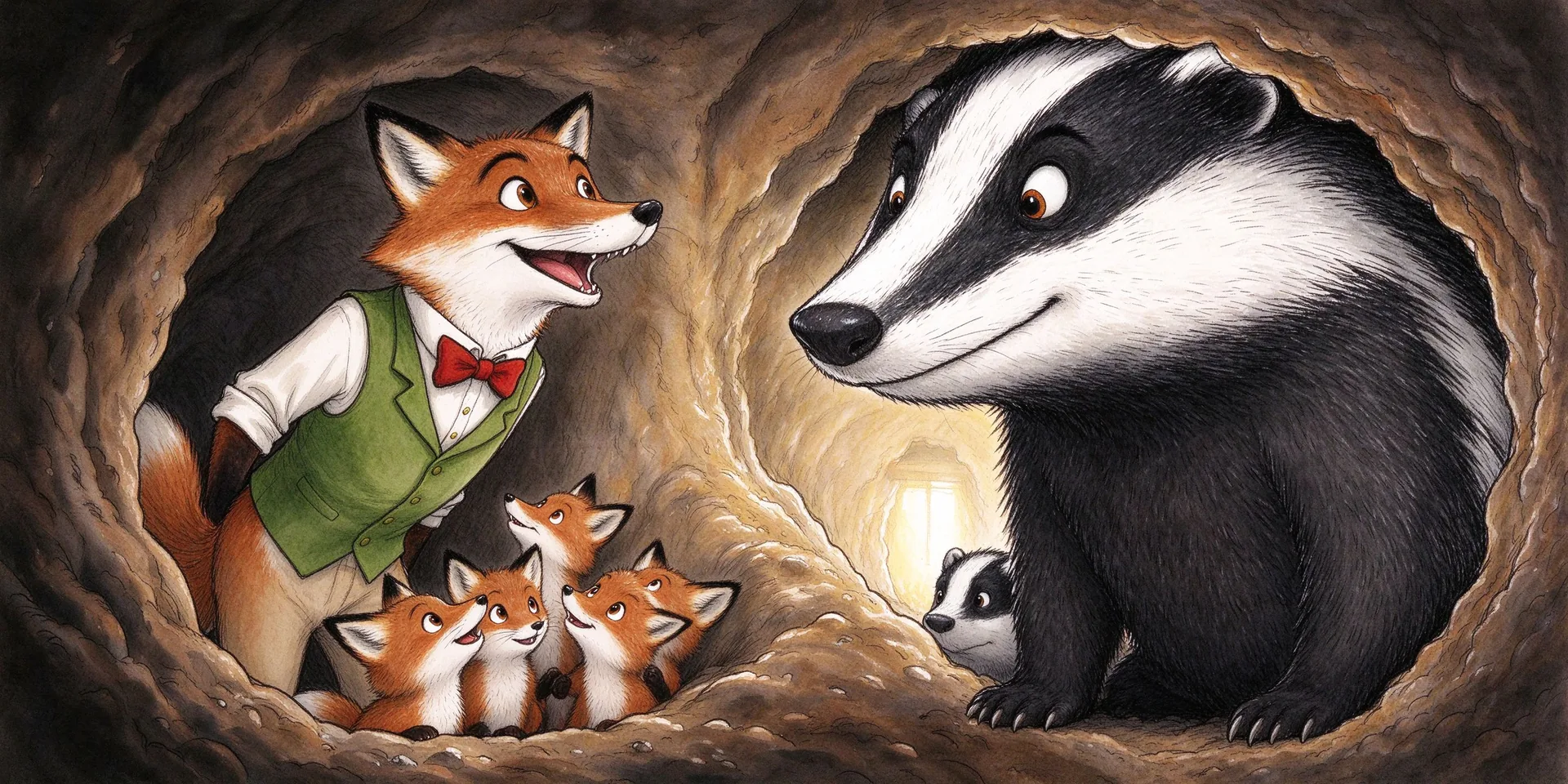
地道里,獾先生从隧道顶部的洞探下头来,狐狸爸爸和三只小狐狸抬头望着他,又惊又喜
Badger —— 地道里的老朋友
12Chapter 12
01 · BEFORE YOU READ

读前热身Before You Read

Mr Fox and his three cubs dig fast and straight, laughing at the thought of Boggis’s chickens. Suddenly a deep voice above their heads cries: “Who goes there?” — it is Badger, digging in circles for three days and nights, completely lost! Badger brings terrible news: the hill is chaos, half the wood has gone, and all the digging animals are starving. Mr Fox smiles: “This mess is all my fault… I invite you to share the feast!” Now read “Badger” and watch a stranger become an old friend — and a feast grow big enough for everyone.狐狸爸爸和三只小狐狸飞快地、笔直地挖着,一想到博吉斯的鸡就咯咯笑。忽然头顶传来一个低沉的声音:“谁在那儿?”——是獾先生!他绕圈挖了三天三夜,完全迷路了!獾带来了坏消息:山丘上乱套了,半个林子没了,所有挖洞的动物都在挨饿。狐狸爸爸笑了:“这摊乱子全是我的错……我邀请你们共享盛宴!”现在来读《獾先生》,看一个陌生人怎样变成老朋友——而一场盛宴,大到装得下所有人。

About the Author · 关于作者

Roald Dahl knows that a bad moment can become a good one — and Chapter 12 is that turn. Badger drops in, lost and starving, and pours out disaster: chaos, guns, half the wood gone, everyone trapped. And Mr Fox answers with one quiet smile: “I invite you to share the feast.” Dahl loves guests — strangers who knock on the door and leave as old friends. Watch how one invitation turns “we’re finished!” into “a Fox’s Feast.”罗尔德·达尔懂得:一个坏时刻,可以变成一个好时刻——第十二章就是这样一个转身。獾先生迷了路、饿着肚子闯进来,倒出一大堆灾难:乱套、枪、半个林子没了、大家都被困住。而狐狸爸爸只用一个平静的微笑回答:“我邀请你们共享盛宴。”达尔爱写客人——敲门时是陌生人,离开时是老朋友。看一个邀请,怎样把“我们完了!”变成“狐狸盛宴”。

What Happened Before · 上一章回顾

In Chapter 11, the biggest Small Fox ran home carrying three plump hens. Mrs Fox, weaker than ever from lack of food, opened one eye and murmured: “I’m dreaming.” But they were real chickens from Boggis’s Chicken House Number One! The sight of food gave her new strength: “A feast it shall be! Hurry up, child, and start plucking those chickens!” Meanwhile, far away down the tunnel, Mr Fox was already planning the next bit: “This one’ll be as easy as pie!”第十一章里,最大的小狐狸抱着三只肥母鸡跑回家。妈妈饿得虚弱,睁开一只眼喃喃:“我在做梦吧。”可那是真鸡,来自博吉斯的1号鸡舍!食物的景象给了她新的力量:“盛宴就要开席了!快,孩子,开始拔那些鸡的毛吧!”与此同时,地道深处,狐狸爸爸已经在盘算下一段:“这一段,易如反掌!”

Reading Tip · 阅读小贴士:Watch three things: ① the voice before the face — “Who goes there?” speaks from above before we meet Badger; ② the bad news — chaos, guns, half the wood gone, everyone starving; ③ the turn — “I invite you to share the feast” — one sentence turns a stranger into a guest and a disaster into a celebration.注意三样东西:①先闻其声,后见其面——“谁在那儿?”的声音从头顶传来,我们还没见到獾先生;②坏消息——乱套、枪、半个林子没了、大家都饿着;③转折——“我邀请你们共享盛宴”——一句话,把陌生人变成客人,把灾难变成庆典。

Predict · 猜一猜

Badger is lost, starving and full of bad news. Mr Fox answers with a smile and an invitation to a feast. What do you think Badger will do?第十二章叫《獾先生》。獾先生迷了路、饿着肚子,带了一肚子坏消息。狐狸爸爸用微笑和一个盛宴邀请回答他。你觉得獾先生会怎么做?

Pick one to remember your prediction — come back after reading to check!
点一个选项记住你的预测,读完全章后回来揭晓答案。

The Answer Is A!Badger is overjoyed: “You mean it? You really mean it?” Mr Fox tells him the secret — they have just been inside Boggis’s Chicken House Number One! “But that is nothing to where we are going now. You can help us dig.” Badger stays, his small son runs off to spread the good news, and everyone is invited to a Fox’s Feast.獾先生喜出望外:“你说真的?你真说真的?”狐狸爸爸告诉他秘密——他们刚从博吉斯的1号鸡舍里出来!“可那跟我们接下来要去的地方比,不算什么。你可以帮我们挖。”獾先生留下来,他的小儿子跑去传播好消息,所有人都被邀请参加狐狸盛宴。

Two more questions after reading · 还有两个小问题:

1. Who did the foxes meet in the tunnel?
狐狸们在地道里遇到了谁?
2. What bad news did Badger bring?
獾先生带来了什么坏消息?

02 · READ & EXPLORE

原文精读Read & Explore

跟着原文读一遍。橙色单词先别查——根据上下文猜一猜。点击任意单词弹出词典卡片(中英释义 · 发音 · 例句);点段落开头的 ▶ 听朗读(英式男声)。

Chapter 12 · Badger

Mr Fox and the three remaining Small Foxes dug fast and straight. They were all too excited now to feel tired or hungry. They knew they were going to have a whacking great feast before long and the fact that it was none other than Boggis’s chickens they were going to eat made them churgle with laughter every time they thought of it. It was lovely to realize that while the fat farmer was sitting up there on the hill waiting for them to starve, he was also giving them their dinner without knowing it. “Keep digging,” said Mr Fox. “It’s not much further.”
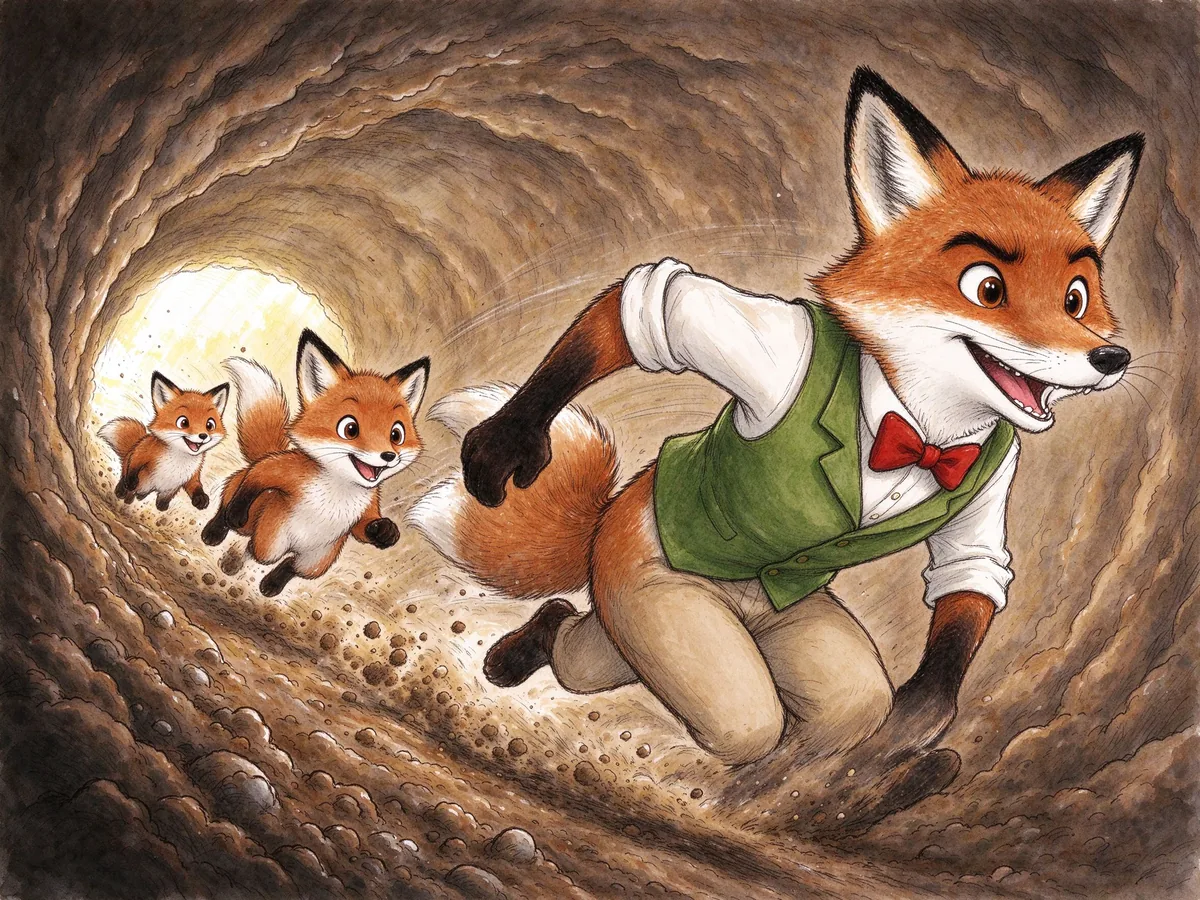
段落大意:狐狸爸爸和三只小狐狸飞快地、笔直地挖。他们太兴奋了,一点也不觉得累和饿。一想到马上要吃大餐,吃的还是博吉斯的鸡,就忍不住咯咯笑。最妙的是:胖农夫坐在山丘上等着他们饿死,却在不知不觉中送上了晚餐。“继续挖,”爸爸说,“不远了。”
地道里,狐狸爸爸和三只小狐狸飞快地挖洞,脸上带着笑,充满干劲
P1 · 边挖边笑 —— 快乐赶路Digging with Joy
表达方式 · 动作描写Expression · Action
Mr Fox and the three remaining Small Foxes dug fast and straight. They were all too excited now to feel tired or hungry.
Dug fast and straight — two adverbs carry the whole mood: speed and purpose. Then Dahl says the best part: too excited to feel tired or hungry. Joy does the work of food and sleep — the body forgets itself when the heart is full.Dug fast and straight——两个副词驮起整个心情:飞快、笔直。然后达尔说出最妙的一句:太兴奋了,连累和饿都顾不上。快乐干完了食物和睡眠的活儿——心满了,身体就忘了自己。
修辞手法 · 反讽Rhetoric · Irony
while the fat farmer was sitting up there on the hill waiting for them to starve, he was also giving them their dinner without knowing it.
The farmer waits to starve the foxes — and feeds them instead. Irony: the trap becomes the gift. The foxes laugh every time they think of it, and so do we.农夫等着饿死狐狸——却反而喂饱了他们。反讽:陷阱变成了礼物。狐狸们每次想到都咯咯笑,我们也跟着笑。

All of a sudden a deep voice above their heads said, “Who goes there?” The foxes jumped. They looked up quickly and they saw, peeking through a small hole in the roof of the tunnel, a long black pointed furry face. “Badger!” cried Mr Fox. “Foxy!” cried Badger. “My goodness me, I’m glad I’ve found someone at last! I’ve been digging around in circles for three days and nights and I haven’t the foggiest idea where I am!”
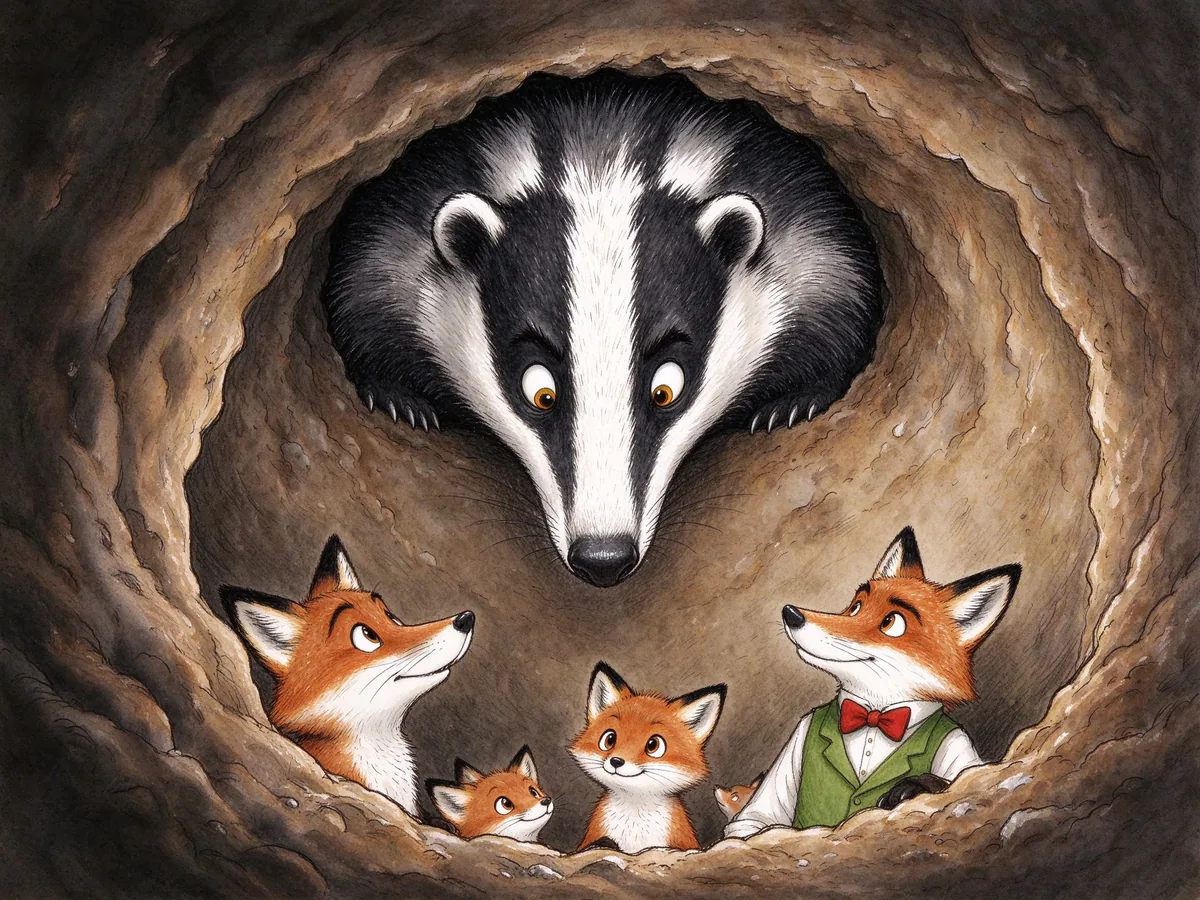
段落大意:忽然,头顶传来一个低沉的声音:“谁在那儿?”狐狸们吓了一跳,抬头一看——隧道顶部的洞里探出一张又长又黑、尖尖的毛茸茸的脸。“獾先生!”狐狸爸爸喊。“狐哥!”獾先生喊,“天哪,终于找到人了!我绕来绕去挖了三天三夜,完全不知道自己在哪里!”
隧道顶部的小洞里探出一张又长又黑、尖尖的毛茸茸的獾脸,狐狸们抬头吃惊地望着
P2 · 先闻其声 —— 獾先生登场A Voice Above
结构手法 · 悬念登场Structure · Suspense
All of a sudden a deep voice above their heads said, “Who goes there?”
The voice comes before the face. We hear “Who goes there?” before we know who speaks — the reader jumps with the foxes. Dahl makes us meet the mystery first, then the answer: a long black pointed furry face.声音先于面孔。我们还没看见说话的人,先听见“谁在那儿?”——读者跟着狐狸们一起跳起来。达尔让我们先遇见谜,再遇见答案:一张又长又黑、尖尖的毛茸茸的脸。
表达方式 · 外貌描写Expression · Appearance
they saw, peeking through a small hole in the roof of the tunnel, a long black pointed furry face.
Long, black, pointed, furry — four adjectives stacked, each adding one clue. And the face is peeking, not looking: a small hole, a shy peek, a stranger. Description builds the picture piece by piece, like a camera zooming in.Long、black、pointed、furry——四个形容词叠在一起,每个加一条线索。而且这张脸是 peeking(探头),不是看着:小洞、探头、陌生人。描写像摄像机推进,一块一块拼出画面。

Badger made the hole in the ceiling bigger and dropped down beside the foxes. A Small Badger (his son) dropped down after him. “Haven’t you heard what’s happening up on the hill?” Badger said excitedly. “It’s chaos! Half the wood has disappeared and there are men with guns all over the countryside! None of us can get out, even at night! We’re all starving to death!”
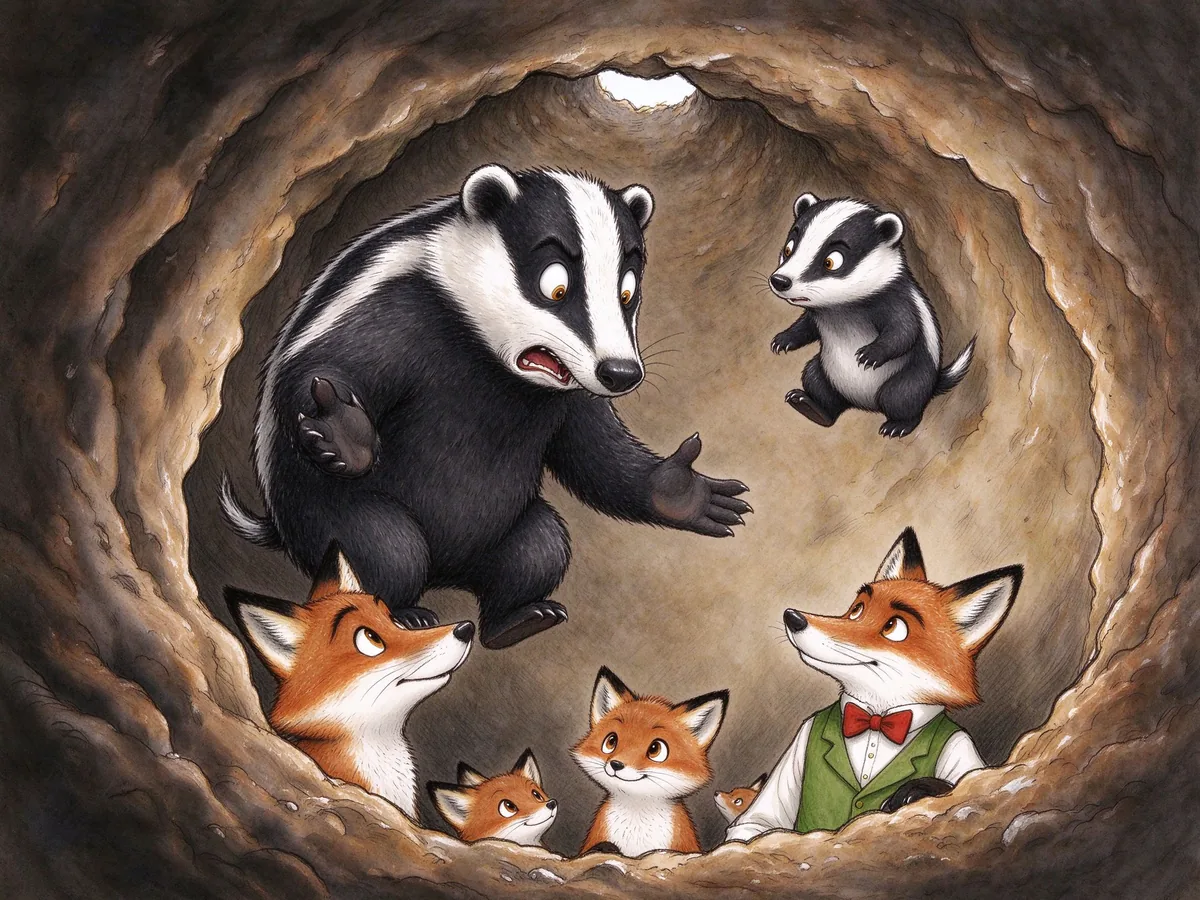
段落大意:獾先生把洞弄大,跳了下来,小獾(他的儿子)也跟着跳下来。“你没听说山丘上发生了什么吗?”獾激动地说,“乱套了!半个林子没了,到处都是拿枪的人!谁也出不去,连晚上都不行!我们都快饿死了!”
獾先生和小獾从隧道顶上跳下来,獾先生激动地比划着,神色焦急,向狐狸们说坏消息
P3 · 坏消息 —— 山上的灾难Bad News
表达方式 · 语言描写Expression · Dialogue
“It’s chaos! Half the wood has disappeared and there are men with guns all over the countryside! None of us can get out, even at night! We’re all starving to death!”
Four exclamation marks in four sentences — the news comes out in bursts, like gunfire. Dahl stacks the disasters: chaos, no wood, guns, trapped, starving. The rhythm of the speech IS the panic: short, loud, unstoppable.四句话,四个感叹号——坏消息像连珠炮一样蹦出来。达尔把灾难叠起来:乱套、没林子、枪、出不去、挨饿。这段话的节奏就是恐慌本身:又短、又响、停不下来。
修辞手法 · 排比Rhetoric · Parallelism
None of us can get out, even at night! We’re all starving to death!
None of us ... We’re all — two short sentences, everyone included. The parallelism widens the disaster from one badger to every digging family: me and Mole and Rabbit and all our wives and children.None of us……We’re all——两个短句,把所有人包进来。排比把灾难从一只獾放大到每一户挖洞的家庭:我、鼹鼠、兔子,还有我们所有的妻子和孩子。

“Who is we?” asked Mr Fox. “All us diggers. That’s me and Mole and Rabbit and all our wives and children. Even Weasel, who can usually sneak out of the tightest spots, is right now hiding down my hole with Mrs Weasel and six kids. What on earth are we going to do, Foxy? I think we’re finished!”
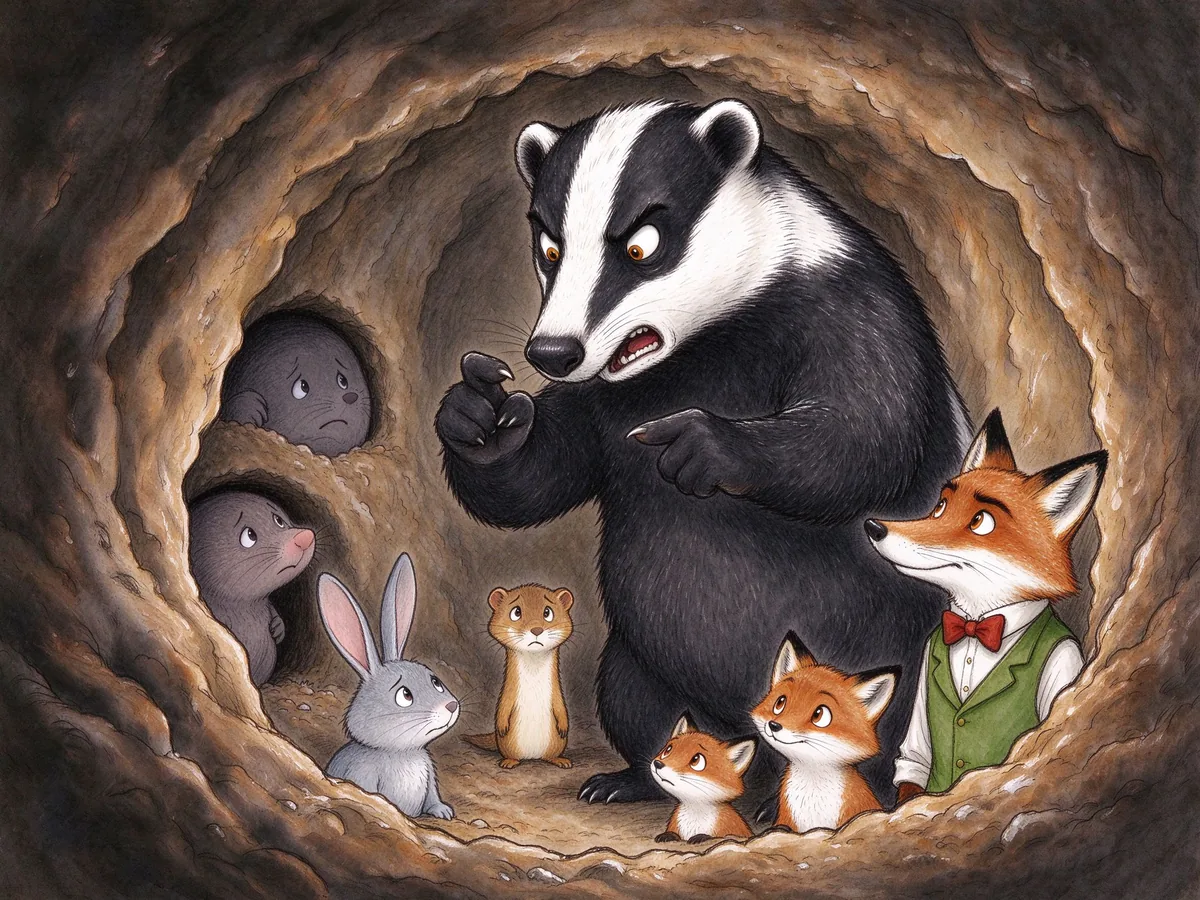
段落大意:“‘我们’是谁?”狐狸爸爸问。“我们这些挖洞的:我、鼹鼠、兔子,还有我们的妻子和孩子。连平时最会钻空子的黄鼠狼,都带着黄鼠狼太太和六个孩子躲在我的洞里。我们到底该怎么办,狐哥?我觉得我们要完了!”
獾先生扳着手指数着鼹鼠、兔子、黄鼠狼这些挖洞的伙伴,狐狸爸爸认真地听着
P4 · 我们是谁 —— 名单里的世界All Us Diggers
特别项 · 一词设问Special · One-Word Question
“Who is we?” asked Mr Fox.
“Who is we?” — grammatically wrong, perfectly right. The grammar mistake is the joke: Mr Fox asks who “we” is as if “we” were one creature. And the answer turns out to be a whole world: Mole, Rabbit, Weasel, and all their families.“Who is we?”——语法是错的,却错得恰到好处。这个语法错误就是笑点:狐狸爸爸问“我们”是谁,好像“我们”是一个生物。而答案原来是一整个世界:鼹鼠、兔子、黄鼠狼,还有他们所有的家。
表达方式 · 语言描写Expression · Dialogue
All us diggers. That’s me and Mole and Rabbit and all our wives and children.
The list rolls out like a family tree: diggers, Mole, Rabbit, wives, children. Dahl lists names instead of explaining — one long chain of and and and. The community is so big it cannot be counted quickly, and that is exactly the point.名单像家谱一样滚出来:挖洞的、鼹鼠、兔子、妻子、孩子。达尔用罗列代替解释——一长串 and 和 and。这个社群大得数不过来,而这正是要点。

Mr Fox looked at his three children and he smiled. The children smiled back at him, sharing his secret. “My dear old Badger,” he said, “this mess you’re in is all my fault . . .” “I know it’s your fault!” said Badger furiously. “And the farmers are not going to give up till they’ve got you. Unfortunately, that means us as well. It means everyone on the hill.” Badger sat down and put a paw around his small son. “We’re done for,” he said softly. “My poor wife up there is so weak she can’t dig another yard.”
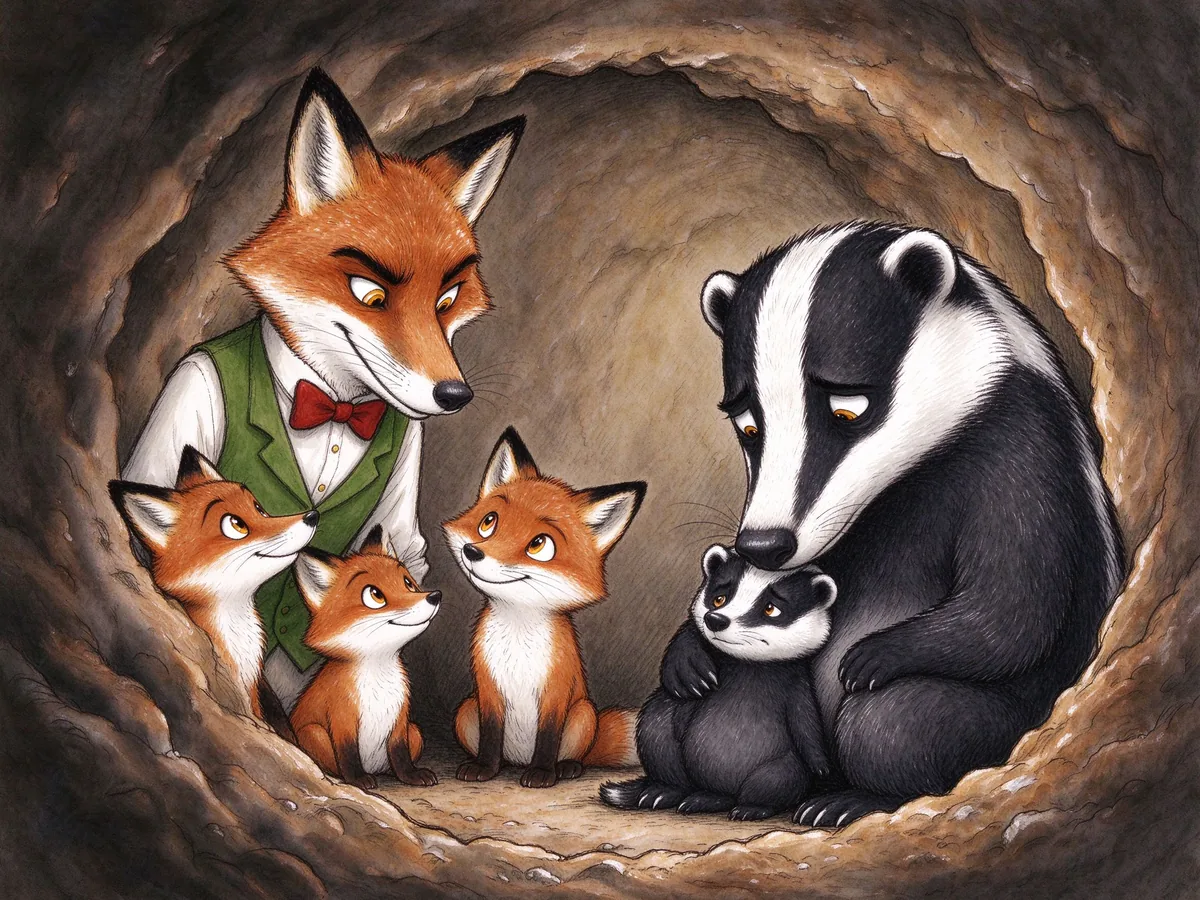
段落大意:狐狸爸爸看着三个孩子,笑了。孩子们也笑了,分享着他的秘密。“亲爱的老獾先生,”他说,“你们落难,全是我的错……”“我知道是你的错!”獾先生怒气冲冲地说,“农夫们抓不到你不会罢休。倒霉的是我们,是山上每一个人。”獾坐下,搂住小儿子:“我们完了,”他轻声说,“我可怜的妻子在上面,弱得连一码都挖不动了。”
獾先生搂着小儿子垂头坐下,神色沮丧,狐狸爸爸看着三个微笑的孩子,胸有成竹
P5 · 道歉与微笑 —— 秘密传递Apology and a Smile
表达方式 · 心理描写Expression · Psychology
Mr Fox looked at his three children and he smiled. The children smiled back at him, sharing his secret.
No words — just smiles. The father and his children share a secret without speaking a single word of it. The smile is the message: the children know what Badger does not. Dahl writes the secret by showing who is in on it.没有语言——只有微笑。爸爸和孩子们不用说出一个字,就共享了一个秘密。微笑就是信息:孩子们知道獾先生不知道的事。达尔不写秘密本身,只写谁在分享它。
表达方式 · 神态描写Expression · Look
“We’re done for,” he said softly. “My poor wife up there is so weak she can’t dig another yard.”
Softly, poor, so weak, can’t dig another yard — despair spoken at a whisper. Badger’s lowest moment is written small and quiet, so that the turn that follows will feel huge. The softer the fall, the higher the rise.Softly、poor、so weak、can’t dig another yard——绝望用耳语说出来。獾先生的最低谷被写得又小又轻,好让后面的转折显得巨大。跌得越轻,弹得越高。

“Nor can mine,” said Mr Fox. “And yet at this very minute she is preparing for me and my children the most delicious feast of plump juicy chickens . . .” “Stop!” cried Badger. “Don’t tease me! I can’t stand it!” “It’s true!” cried the Small Foxes. “Dad’s not teasing! We’ve got chickens galore!” “And because everything is entirely my fault,” said Mr Fox, “I invite you to share the feast. I invite everyone to share it — you and Mole and Rabbit and Weasel and all your wives and children. There’ll be plenty to go round, I can assure you.”
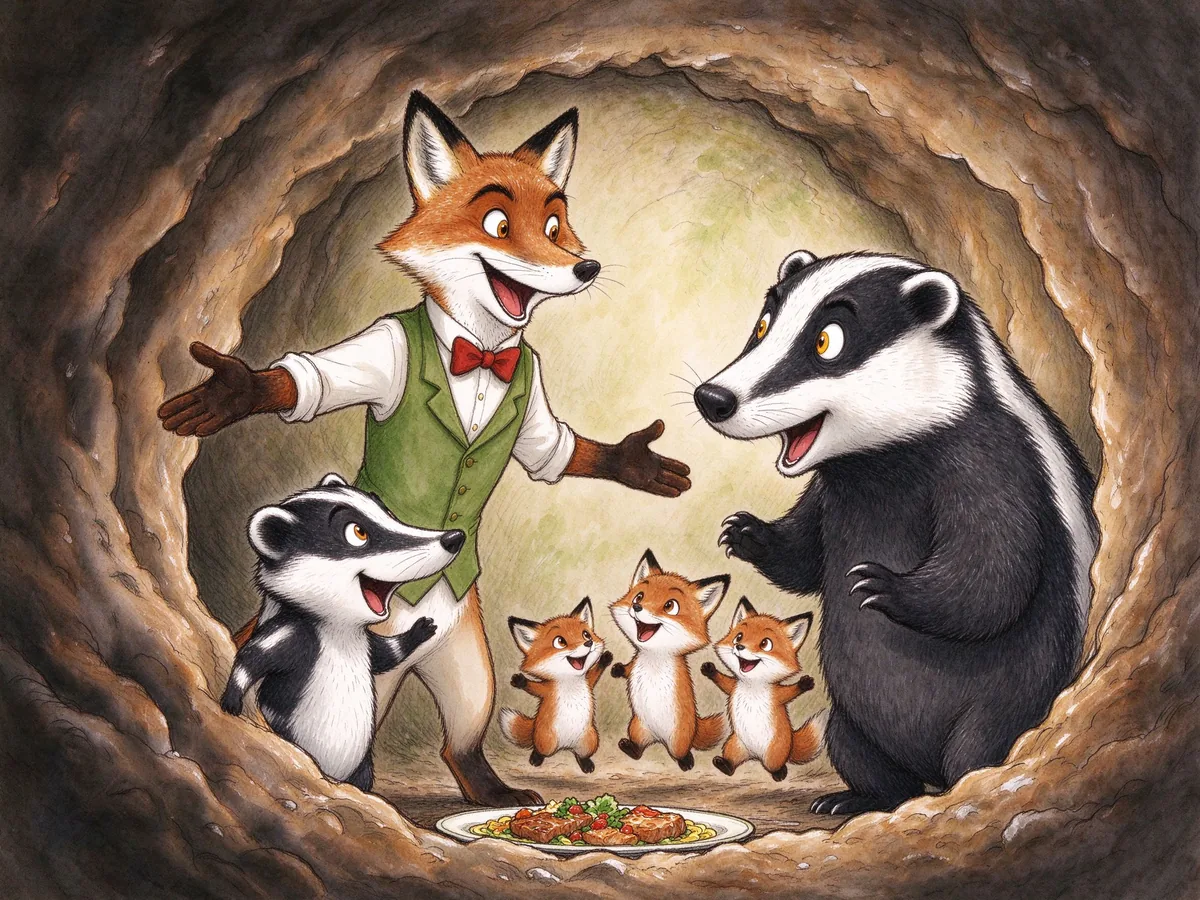
段落大意:“我妻子也一样,”狐狸爸爸说,“可就在此刻,她正在为我们准备最香喷喷的大餐——肥美多汁的鸡……”“别说了!”獾喊,“别逗我!我受不了!”“是真的!”小狐狸们喊,“爸爸没逗你!我们的鸡多得是!”“既然一切都是我的错,”狐狸爸爸说,“我邀请你们共享盛宴。我邀请所有人——你、鼹鼠、兔子、黄鼠狼,还有你们的妻子和孩子。我保证,够分。”
狐狸爸爸张开双臂,正式邀请獾先生和小獾共享盛宴,獾先生瞪大眼睛又惊又喜
P6 · 一个邀请 —— 把灾难变盛宴One Invitation
修辞手法 · 排比Rhetoric · Parallelism
I invite you to share the feast. I invite everyone to share it — you and Mole and Rabbit and Weasel and all your wives and children.
I invite you. I invite everyone. The sentence repeats itself and grows — one guest becomes a whole hill of guests. The chain of and and and stretches the table wide enough for every family. Invitation by repetition: the more he repeats, the more generous it sounds.I invite you. I invite everyone.句子重复自己,并且长大——一位客人变成满山坡的客人。一长串 and 把餐桌拉得够宽,装得下每个家庭。用反复来邀请:说得越多,越显慷慨。
表达方式 · 语言描写Expression · Dialogue
“Stop!” cried Badger. “Don’t tease me! I can’t stand it!” ... “Dad’s not teasing! We’ve got chickens galore!”
Tease and not teasing — the same word flips between two speakers. Badger begs him to stop; the cubs insist it is true. The argument over one word is how Dahl proves the feast is real: you believe it when the children shout it.Tease 和 not teasing——同一个词在两个说话人之间翻面。獾先生求他别说;小狐狸坚持这是真的。为了一个词吵架,正是达尔证明盛宴真实的方式:孩子们喊出来的时候,你就信了。

“You mean it?” cried Badger. “You really mean it?” Mr Fox pushed his face close to Badger’s and whispered darkly, “Do you know where we’ve just been?” “Where?” “Right inside Boggis’s Chicken House Number One!” “No!” “Yes! But that is nothing to where we are going now. You have come just at the right moment, my dear Badger. You can help us dig. And in the meanwhile, your small son can run back to Mrs Badger and all the others and spread the good news.” Mr Fox turned to the Small Badger and said, “Tell them they are invited to a Fox’s Feast. Then bring them all down here and follow this tunnel back until you find my home!” “Yes, Mr Fox!” said the Small Badger. “Yes, sir! Right away, sir! Oh, thank you, sir!” and he scrambled quickly back through the hole in the roof of the tunnel and disappeared.
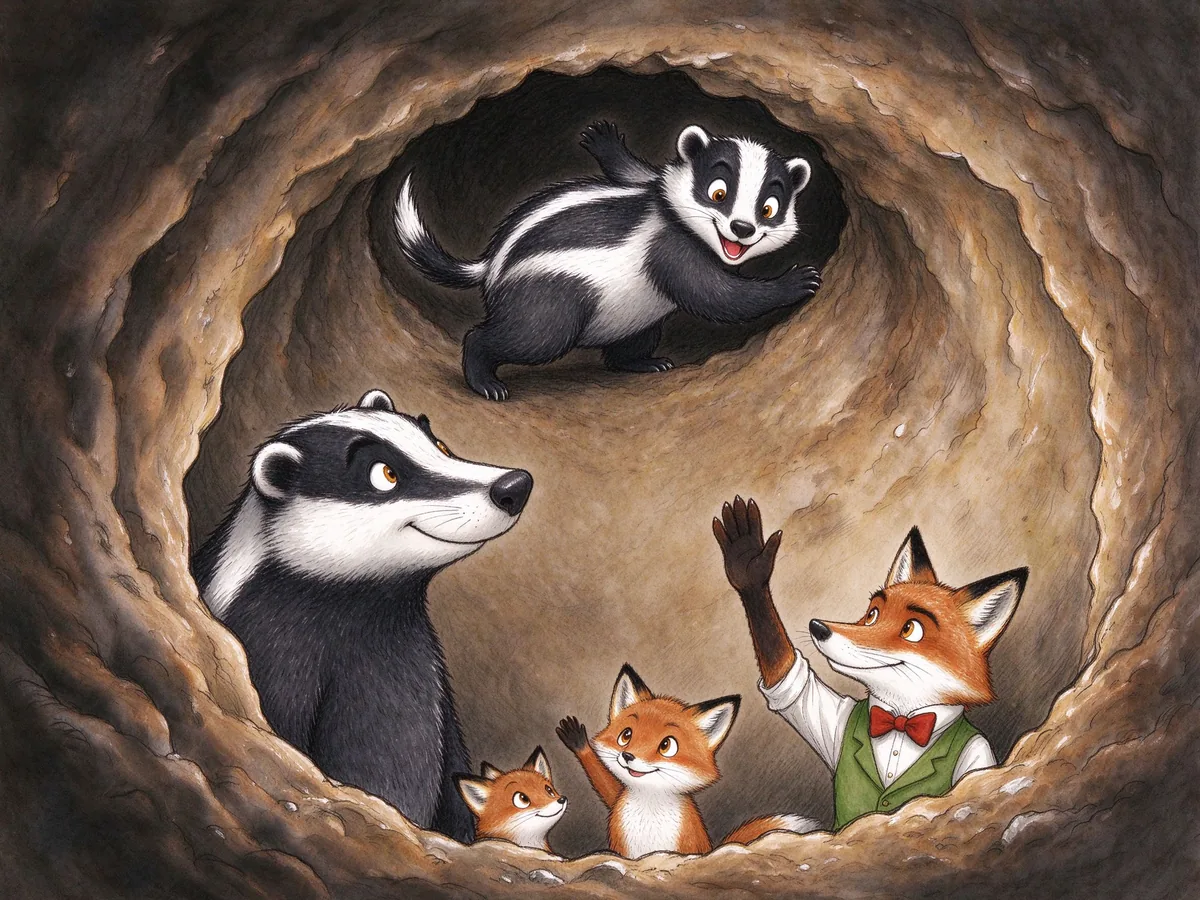
段落大意:“你说真的?”獾喊,“你真说真的?”狐狸爸爸凑近獾的脸,神秘地低语:“你知道我们刚从哪儿来吗?”“哪儿?”“博吉斯的1号鸡舍!”“不会吧!”“真的!可那跟我们接下来要去的地方比,不算什么。你来得正是时候,亲爱的獾先生。你帮我们挖。同时,你的小儿子跑回去告诉大家这个好消息。”狐狸爸爸对小獾说:“告诉他们,他们被邀请参加狐狸盛宴。然后带他们下到这里,沿着这条隧道一直走,就能找到我家!”“好的,狐狸先生!”小獾说,“好的,先生!马上就去!哦,谢谢您,先生!”他飞快地钻回隧道顶部的洞口,不见了。
狐狸爸爸低声说出秘密,小獾兴奋地敬礼答应,转身飞快爬回洞口去传好消息
P7 · 狐狸盛宴 —— 好消息出发A Fox’s Feast
表达方式 · 动作描写Expression · Action
he scrambled quickly back through the hole in the roof of the tunnel and disappeared.
Scrambled, quickly, back, disappeared — the chapter ends on movement. The little badger does not walk away; he scrambles. Dahl closes the door of the scene with one vanishing act, and the whole next adventure rides out on those fast little feet.Scrambled、quickly、back、disappeared——全章结束在一个动作上。小獾不是走开的,是连爬带跑冲出去的。达尔用一次消失关上了场景的门,而整个下一场冒险,就坐在那双飞快的小脚上出发了。
结构手法 · 首尾呼应Structure · Echo
Follow this tunnel back until you find my home!
The tunnel that brought Badger in now carries the whole hill back to the feast. Earlier the foxes dug straight and fast; now others will follow the same tunnel home. One tunnel, two directions — in the first half it was their escape, in the second it is everyone’s doorway.把獾先生带进来的那条隧道,现在驮着满山坡的动物走向盛宴。前面狐狸们笔直飞快地挖;现在,别人将沿着同一条隧道回家。一条隧道,两个方向——前半章是他们的逃生路,后半章成了所有人的家门。
03 · CHARACTER CARDS

人物档案Who Is on Stage Tonight

这一章:地道里来了一位不速之客——獾先生。他迷路三天三夜,倒出满山坏消息;狐狸爸爸用一个微笑、一句道歉、一个邀请,把灾难变成盛宴——“我邀请所有人共享。”

THE HOST

Mr Fox

狐狸先生 · 微笑的东道主
SMILE 微笑Mr Fox looked at his three children and he smiled. The children smiled back at him, sharing his secret. 一句话不说,秘密已传开
OWN 认错“This mess you’re in is all my fault . . .” 不推诿,先把责任扛下来
INVITE 邀请“I invite you to share the feast. I invite everyone to share it.” 把盛宴从一家,变成一山
THE LOST GUEST

Badger

獾先生 · 迷路的客人
LOST 迷路I’ve been digging around in circles for three days and nights and I haven’t the foggiest idea where I am! 绕圈挖了三天三夜,完全迷路
NEWS 坏消息It’s chaos! Half the wood has disappeared and there are men with guns all over the countryside! 满山灾难,倒豆子一样倒出来
HOPE 希望“You mean it? You really mean it?” cried Badger. 从“我们完了”到“你说真的?”
THE MESSENGER

The Small Badger

小獾 · 报信的小使者
JUMP 跳下A Small Badger (his son) dropped down after him. 爸爸跳下,他也跟着跳下
RUN 奔跑he scrambled quickly back through the hole in the roof of the tunnel and disappeared. 一声答应,转身就冲回去报信
POLITE 有礼“Yes, Mr Fox! Yes, sir! Right away, sir! Oh, thank you, sir!” 三连答,快乐又懂礼貌

描写分析 · Descriptions That Move the Story

描写分析仅限本章内容。这一章写「陌生来客」:记叙文写「转变」,常用外貌(黑尖毛脸)写陌生、用语言(坏消息与邀请)写转折、用神态(微笑与耳语)写秘密、用动作(钻洞消失)写行动——每一处描写,都在推动情节转向盛宴。

人物描写 · CHARACTER外貌 · 语言 · 动作 · 心理 · 神态
外貌描写 · APPEARANCE

they saw, peeking through a small hole in the roof of the tunnel, a long black pointed furry face.

Long, black, pointed, furry — four adjectives build a stranger from nothing. The face is peeking through a small hole, not standing before them: the description of the face IS the suspense, piece by piece, like a camera zooming in.

Long、black、pointed、furry——四个形容词,从零开始搭起一个陌生人。而且这张脸是隔着一个小洞探头,不是站在面前:对脸的描写本身就是悬念,像镜头一格一格推近。

语言描写 · SPEECH

“It’s chaos! Half the wood has disappeared and there are men with guns all over the countryside!” … “I invite you to share the feast. I invite everyone to share it.”

Two speeches carry the whole turn: first Badger’s panic bursts out in short loud sentences; then Mr Fox answers in one calm, growing sentence. Dialogue shows the whole change — from disaster to invitation.

两段话承载了整个转折:先听獾先生用又短又响的句子倒出恐慌;再听狐狸爸爸用一句平静的、不断变长的句子回答。对话写出了全部变化——从灾难,到邀请。

动作描写 · ACTION

he scrambled quickly back through the hole in the roof of the tunnel and disappeared.

Scrambled, quickly, disappeared — the little badger does not walk away, he scrambles. One fast action closes the chapter and carries the good news out of sight. The body moves before the words do.

Scrambled、quickly、disappeared——小獾不是走开的,是连爬带跑冲出去的。一个利落的动作收束全章,把好消息送出视线之外。身体先于语言行动。

心理描写 · PSYCHOLOGY

Mr Fox looked at his three children and he smiled. The children smiled back at him, sharing his secret.

No words — just smiles. The father and his children share a secret without speaking it. Dahl shows the inside of the family by showing who is in on the secret: the children know what Badger does not.

没有语言——只有微笑。爸爸和孩子们不用说出一个字,就共享了秘密。达尔不写内心,只写谁在分享这个秘密:孩子们知道獾先生不知道的事。

神态描写 · EXPRESSION

“We’re done for,” he said softly. “My poor wife up there is so weak she can’t dig another yard.”

Softly, poor, so weak — despair spoken at a whisper. Badger’s lowest moment is written small and quiet, so that the turn that follows feels huge. The softer the fall, the higher the rise.

Softly、poor、so weak——绝望用耳语说出来。獾先生的最低谷被写得又小又轻,好让后面的转折显得巨大。跌得越轻,弹得越高。

环境描写 · ENVIRONMENT场景 · 景物 · 氛围
环境描写 · ENVIRONMENT

“It’s chaos! Half the wood has disappeared and there are men with guns all over the countryside! None of us can get out, even at night!”

The hill outside is written as a world of loss: half the wood gone, men with guns, no one can get out even at night. The dangerous outside makes the tunnel feel like a shelter — the darker the hill, the safer the hole.

外面的山丘被写成一个失去的世界:半个林子没了、到处是拿枪的人、连晚上都出不去。危险的外面,让地道显得像个庇护所——山丘越暗,地洞越安全。

文章结构 · Story Structure 陌生来客 · A Stranger Comes

这一章是「一个陌生来客如何变成老朋友」的转变链条:挖洞赶路 → 先闻其声 → 坏消息 → 谁是“我们” → 道歉与邀请 → 狐狸盛宴。灾难一环转成一环,从山上的黑暗,转到地下的盛宴。

挖洞赶路OPENING爸爸和三只小狐狸,飞快地笔直地挖
先闻其声STEP 1头顶传来声音:谁在那儿?——獾先生!
坏消息STEP 2乱套!半个林子没了,大家都快饿死
道歉邀请STEP 3全是我的错——我邀请你们共享盛宴
狐狸盛宴CLOSING小獾钻回洞口,好消息出发了
Para 1 · 开场 · 挖洞赶路

Mr Fox and the three remaining Small Foxes dug fast and straight. They were all too excited now to feel tired or hungry.

狐狸爸爸和三只小狐狸飞快地、笔直地挖。太兴奋了,连累和饿都顾不上。

How it expands · 怎么展开:围绕 too excited to feel tired or hungry 展开:先给状态(挖得快而直),再给理由(快乐代替了疲劳)。一个“连饿都顾不上”,把期待拉到最满。

推进 · Steps ×4先闻其声 → 坏消息 → 道歉邀请 → 狐狸盛宴
Step 2 · 先闻其声

All of a sudden a deep voice above their heads said, “Who goes there?”

忽然,头顶传来一个低沉的声音:谁在那儿?

How it expands · 怎么展开:用「悬念」展开:声音先于面孔——读者和狐狸们一起跳起来,再顺着“一个小洞里探出的黑尖毛脸”见到獾先生。先吊胃口,再揭答案。

Step 3 · 坏消息

It’s chaos! Half the wood has disappeared and there are men with guns all over the countryside! We’re all starving to death!

乱套了!半个林子没了,到处都是拿枪的人!我们都快饿死了!

How it expands · 怎么展开:坏消息用「连珠炮」展开:四个感叹号、四层灾难——乱套、没林子、枪、挨饿。越说越响,恐慌本身就成了节奏。

Step 4 · 道歉与邀请

Mr Fox looked at his three children and he smiled. “I invite you to share the feast. I invite everyone to share it.”

狐狸爸爸看着孩子,笑了。我邀请你们共享盛宴。我邀请所有人共享。

How it expands · 怎么展开:转折用「微笑 + 邀请」展开:先微笑分享秘密,再认错,最后把盛宴铺开——一句“全是我的错”,把陌生人变成座上客。

Step 5 · 收束 · 狐狸盛宴

he scrambled quickly back through the hole in the roof of the tunnel and disappeared.

小獾飞快地钻回隧道顶部的洞口,不见了。

How it expands · 怎么展开:收束用「行动」展开:好消息不是靠说完成的,是靠一双飞快的小脚送出去的。动作落笔,全章定格,把下一场冒险送出洞口。

按结构复述 · Retell by Structure(陌生来客)

这是「陌生来客」结构,复述时沿着转变的脚步走:挖洞赶路 → 先闻其声 → 坏消息 → 道歉邀请 → 狐狸盛宴。

First · 挖洞赶路Mr Fox and the three Small Foxes dug fast and straight. They were too excited to feel tired or hungry.狐狸爸爸和三只小狐狸飞快地挖,兴奋得忘了累和饿。
Then · 先闻其声All of a sudden a deep voice above their heads said: “Who goes there?” It was Badger, lost for three days and nights.忽然头顶传来一个声音:「谁在那儿?」——是迷路了三天三夜的獾先生。
Next · 坏消息“It’s chaos! Half the wood has disappeared! We’re all starving to death!” Badger said excitedly.「乱套了!半个林子没了!我们都快饿死了!」獾先生激动地说。
Then · 道歉邀请Mr Fox smiled and shared his secret: “This mess is all my fault. I invite you to share the feast.”狐狸爸爸笑了,分享他的秘密:「全是我的错。我邀请你们共享盛宴。」
Finally · 狐狸盛宴The Small Badger scrambled back through the hole: everyone is invited to a Fox’s Feast.小獾飞快地钻回洞口:所有人都被邀请参加狐狸盛宴。

小提示:与「思维导图」搭配用——把导图的枝条按 挖洞赶路 → 先闻其声 → 坏消息 → 道歉邀请 → 狐狸盛宴 排好,先看导图复述一遍,再合上导图凭记忆复述一遍。

一处文字,两个场景 · Two Scenes in One

On the Hill ↑ 山上chaos · 半个林子没了 · 都饿着
In the Tunnel ↓ 地道“share the feast” · 邀请 · 狐狸盛宴

示意图:镜头在「山上的灾难」和「地道的盛宴」之间切换——外面是世界末日,里面是家的灯火。

04 · STORY MAP & RETELL

思维导图 · 复述文章Story Map & Retelling

把第十二章的信息装进这张「思维导图」,再沿着复述支架讲一遍——你也能当小老师!

Badger
地点人物情节关键结果

复述支架 · Retell with the scaffold

把句子补充完整,就完成了第十二章的复述。

1
Badger made the hole in the ceiling bigger and dropped down beside the ________.
2
I’ve been digging around in circles for three days and ________.
3
It’s chaos! Half the ________ has disappeared!
4
I invite you to ________ the feast. I invite everyone to share it.
5
Right inside Boggis’s Chicken House Number ________!
6
He scrambled quickly back through the hole and ________.

复述加分:用 First / Then / Next / Also / Finally 把六句话串起来;讲到“Who goes there?”压低声音,读出头顶的悬念;讲到“I invite you to share the feast”放慢放稳,读出东道主的大气——陌生来客,变成座上宾!

05 · PICTURE RETELL

看图复述Retell with Pictures

7 张图卡按情节顺序排好。看着图片,用英文把第十二章讲出来——点击图片可以放大,每张图点开都有一句「提示句」帮你起头。

1地道里,狐狸爸爸和三只小狐狸飞快地挖洞,脸上带着笑,充满干劲
挖洞赶路
Say: Mr Fox and the three remaining Small Foxes dug fast and straight. They were all too excited now to feel tired or hungry.
“狐狸爸爸和三只小狐狸飞快地、笔直地挖。他们太兴奋了,连累和饿都顾不上。”
2隧道顶部的小洞里探出一张又长又黑、尖尖的毛茸茸的獾脸,狐狸们抬头吃惊地望着
先闻其声
Say: All of a sudden a deep voice above their heads said, “Who goes there?” They looked up and saw, peeking through a small hole, a long black pointed furry face. “Badger!” cried Mr Fox.
“忽然头顶传来一个低沉的声音:「谁在那儿?」他们抬头一看——一个小洞里探出一张又长又黑、尖尖的毛茸茸的脸。「獾先生!」狐狸爸爸喊。”
3獾先生和小獾从隧道顶上跳下来,獾先生激动地比划着,神色焦急,向狐狸们说坏消息
坏消息
Say: Badger made the hole in the ceiling bigger and dropped down beside the foxes. “It’s chaos! Half the wood has disappeared and there are men with guns all over the countryside! We’re all starving to death!”
“獾先生把洞弄大,跳到狐狸们身边:「乱套了!半个林子没了,到处都是拿枪的人!我们都快饿死了!」”
4獾先生扳着手指数着鼹鼠、兔子、黄鼠狼这些挖洞的伙伴,狐狸爸爸认真地听着
谁是"我们"
Say: “Who is we?” asked Mr Fox. “All us diggers. That’s me and Mole and Rabbit and all our wives and children. Even Weasel is right now hiding down my hole with Mrs Weasel and six kids.”
“「「我们」是谁?」狐狸爸爸问。「我们这些挖洞的:我、鼹鼠、兔子,还有我们所有的妻子和孩子。连黄鼠狼都躲在我洞里,带着太太和六个孩子。」”
5獾先生搂着小儿子垂头坐下,神色沮丧,狐狸爸爸看着三个微笑的孩子,胸有成竹
道歉与微笑
Say: Mr Fox looked at his three children and he smiled. The children smiled back at him, sharing his secret. “My dear old Badger,” he said, “this mess you’re in is all my fault.”
“狐狸爸爸看着三个孩子,笑了。孩子们也笑了,分享着他的秘密。「亲爱的老獾先生,」他说,「你们落难,全是我的错。」”
6狐狸爸爸张开双臂,正式邀请獾先生和小獾共享盛宴,獾先生瞪大眼睛又惊又喜
一个邀请
Say: “Stop!” cried Badger. “Don’t tease me! I can’t stand it!” “It’s true!” cried the Small Foxes. “Dad’s not teasing! We’ve got chickens galore!” “I invite you to share the feast. I invite everyone to share it.”
“「别说了!」獾喊,「别逗我!我受不了!」「是真的!」小狐狸们喊,「爸爸没逗你!我们的鸡多得是!」「我邀请你们共享盛宴。我邀请所有人共享。」”
7狐狸爸爸低声说出秘密,小獾兴奋地敬礼答应,转身飞快爬回洞口去传好消息
狐狸盛宴
Say: “Right inside Boggis’s Chicken House Number One!” … Mr Fox turned to the Small Badger and said, “Tell them they are invited to a Fox’s Feast.” “Yes, Mr Fox! Right away, sir!” and he scrambled quickly back through the hole and disappeared.
“「就在博吉斯的1号鸡舍里面!」……狐狸爸爸对小獾说:「告诉他们,他们被邀请参加狐狸盛宴。」「好的,狐狸先生!马上就去!」他飞快地钻回洞口,不见了。”

提示:图卡可左右滑动查看全部 7 张;点「看看提示句」展开英文句子;点图片放大全屏。

1 · First 挖洞赶路→ 2 · Then 先闻其声→ 3 · Next 坏消息→ 4 · Also 谁是"我们"→ 5 · Then 道歉与微笑→ 6 · Also 一个邀请→ 7 · Finally 狐狸盛宴

小挑战:先看着图讲一遍,再合上图卡,只凭记忆讲一遍——能做到,第十二章就真正属于你了!

06 · WRITER’S CRAFT

写作亮点分析Why This Writing Works

这一章,Dahl 不写「灾难本身」,写「灾难怎么变成盛宴」:一声头顶传来的问话、一张探出洞口的毛脸、一连串坏消息、一个微笑、一句道歉、一场邀请所有人的盛宴。秘密武器是这六招:

Voice Before the Face · 先闻其声
结构手法 · 悬念登场,陌生来客
All of a sudden a deep voice above their heads said, “Who goes there?” The foxes jumped. They looked up quickly and they saw, peeking through a small hole in the roof of the tunnel, a long black pointed furry face.

声音先于面孔:我们还没见到獾先生,先听见“谁在那儿?”。达尔让读者和狐狸们一起跳起来——先吊起好奇心,再让一张黑尖毛脸慢慢探出来。悬念登场:谁在说话?——原来是迷路的獾先生。

小任务:用「先闻其声」写新角色出场:A small voice came from under the bed, “Who’s there?”(床底传来一个小声音:「谁呀?」)
中文写作对照 · 先声夺人 voice first

还没看见人,先听见声音——中文叫「先声夺人」或「未见其人,先闻其声」;像“还没进门,先听见笑声”,一句话就把读者的耳朵叫醒。

The Bad-News Machine · 坏消息连珠炮
表达方式 · 语言描写,恐慌即节奏
“It’s chaos! Half the wood has disappeared and there are men with guns all over the countryside! None of us can get out, even at night! We’re all starving to death!”

四句话,四个感叹号——坏消息像连珠炮一样蹦出来。Dahl 把灾难叠起来:乱套、没林子、枪、出不去、挨饿。越说越响,句子越短,恐慌本身就成了节奏——读者跟着獾先生一起心跳加速。

小任务:用短句连发写坏消息:It’s raining! The road is flooded! We can’t get home!(下雨了!路淹了!我们回不了家!)
中文写作对照 · 短句排比 short bursts

用一串又短又响的句子倒出坏消息——中文叫「短句排比」或「连珠炮」;“乱了!没了!出不去!”,三个短句,一口气把恐慌倒完。

The Growing Invitation · 会变大的邀请
修辞手法 · 排比,一句请来一山坡
“I invite you to share the feast. I invite everyone to share it — you and Mole and Rabbit and Weasel and all your wives and children. There’ll be plenty to go round, I can assure you.”

I invite you. I invite everyone. 句子重复自己,并且长大——一位客人变成满山坡的客人。一长串 and 把餐桌拉得够宽:你、鼹鼠、兔子、黄鼠狼、所有的妻子和孩子。反复之中,盛宴越铺越大,慷慨越来越响。

小任务:用排比写邀请:You are welcome. Everyone is welcome. Come and join us!(欢迎你。欢迎每个人。来加入我们吧!)
中文写作对照 · 排比 parallelism

同一句式一唱三叹,把气势推上去——中文叫「排比」;“邀请你,邀请你们,邀请所有人”,一层比一层大,热情一层比一层高。

Done For to Done For? · 从"完了"到"真的?"
表现手法 · 欲扬先抑,绝望垫高惊喜
“We’re done for,” he said softly. “My poor wife up there is so weak she can’t dig another yard.” ... “You mean it?” cried Badger. “You really mean it?”

先压低(我们完了、妻子弱得挖不动一码),再抬高(你说真的?你真说真的?)。没有前面的“抑”,就没有这一刻的“扬”——绝望说得越轻、越软,惊喜来得就越重、越响。从谷底弹到山顶,全靠这一压一弹。

小任务:用「先抑后扬」写反转:We thought the game was lost. Then we scored two goals in a minute!(我们以为比赛输了。然后一分钟连进两球!)
中文写作对照 · 欲扬先抑 rise after fall

先写绝望,再写希望,落差越大越动人——中文叫「欲扬先抑」;“方才还说完了,转眼宴席就摆开”,跌得越低,弹得越高。

Chaos vs. Feast · 山上的乱与地下的宴
表现手法 · 反衬,一暗一明
“It’s chaos! Half the wood has disappeared and there are men with guns all over the countryside!” ... “I invite you to share the feast. I invite everyone to share it.”

一个镜头,两个世界:山上乱套、没林子、拿枪的人到处都是;地下盛宴、邀请、“够分”。Dahl 用灾难反衬温暖——外面的世界越黑暗,地道里的灯火越明亮。反衬不用解释,对比自己会说话。

小任务:用反衬写对比:Outside the wind was howling. Inside, the fire was warm and dinner was ready.(外面狂风呼啸。里面,炉火正暖,晚饭已备好。)
中文写作对照 · 反衬 contrast

用相反的事物互相衬托,一暗一明——中文叫「反衬」;“外面天寒地冻,屋里热气腾腾”,越冷越显得暖,越乱越显得安。

Golden Line · 金句摘抄
特别项 · 话说一半的悬念
“Right inside Boggis’s Chicken House Number One!” “No!” “Yes! But that is nothing to where we are going now.”

全章最亮的一句,是话说一半的悬念:刚听完一个惊人的秘密,狐狸爸爸又说“可那跟我们接下来要去的地方比,不算什么”。这一句像抛向未来的钩子——读者刚落地,又被吊起来。下一章:Bunce’s Giant Storehouse!抄进你的好句本吧。

挑战:用「话说一半」写悬念:This cake is good, but it is nothing to what is coming next!(这个蛋糕不错,可跟我们接下来要吃的比,不算什么!)
中文写作对照 · 留白悬念 cliffhanger

关键信息说到一半就停,把钩子留给下一章——中文叫「留白」或「卖关子」;“这还不算什么,好戏还在后头呢”,一句话,把读者的心吊到下一回。

句子银行 · Sentence Bank(仿写句型)

too + 形容词 + to do(太……而不能……)
They were all too excited now to feel tired or hungry.
仿写:She was too shy to speak. 她太害羞,说不出话。
现在分词作状语:peeking / sharing
They saw, peeking through a small hole, a long black pointed furry face. The children smiled back at him, sharing his secret.
仿写:She ran home, carrying a big box. 她抱着一个大盒子跑回家。
be done for(完蛋了)
“We’re done for,” he said softly.
仿写:If we miss the bus, we are done for. 如果错过公交车,我们就完了。
invite + 人 + to do(邀请某人做某事)
I invite you to share the feast. I invite everyone to share it.
仿写:Mum invited us to have dinner together. 妈妈邀请我们一起吃晚饭。
名词 + galore(多得是)
We’ve got chickens galore!
仿写:There are books galore in the library. 图书馆里的书多得是。

中西对照小发现:英文 voice before the face 就是中文「先声夺人」,the bad-news machine 就是「短句排比」,the growing invitation 就是「排比」,done for to really? 就是「欲扬先抑」,chaos vs feast 就是「反衬」,golden line 里的话说一半就是「留白悬念」。给小朋友讲的时候,中英文术语可以互相借用,哪边熟讲哪边。

07 · THINK DEEPER

思考题Questions to Think About

三个难度层级:先找细节,再推原因,最后谈看法。点「提示」给一点帮助,点「答案」对照想法——每道题都有英文参考答案和中文释义。

L1 · 细节 Detail

1. Who did the foxes meet in the tunnel? 狐狸们在地道里遇到了谁?

想一想:那张从隧道顶上的小洞里探出的黑尖毛脸是谁?
They met Badger, who had been lost for three days and nights.他们遇到了迷路三天三夜的獾先生。

2. How long had Badger been digging around? 獾先生绕来绕去挖了多久?

“I’ve been digging around in circles for three days and ___ .”
For three days and nights.三天三夜。

3. What did Mr Fox invite Badger to do? 狐狸爸爸邀请獾先生做什么?

“I invite you to ___ the feast.”
To share the feast.共享盛宴。

L2 · 推断 Inference

4. Why couldn’t Badger find his way out? 獾先生为什么找不到路?

他说自己是怎么挖的?挖了多久?
Because he had been digging around in circles for three days and nights — he had no idea where he was.因为他绕圈挖了三天三夜——完全不知道自己在哪儿,越挖越迷。

5. Why did Mr Fox say the mess was all his fault? 狐狸爸爸为什么说这摊乱子全是他的错?

农夫们为什么要挖山?他们在追谁?
Because the farmers were digging to catch him — and their machines destroyed the hill, so every digging family suffered because of him.因为农夫们挖山是为了抓他——机器毁掉了山坡,所有挖洞的家庭都因他而遭殃。

6. Why did Badger cry “Don’t tease me!”? 獾先生为什么喊「别逗我!」?

想一想:他饿了多少天?一顿盛宴对他来说像什么?
Because he was starving and the feast sounded too good to be true — he was afraid it was a joke.因为他快饿死了,盛宴好得不像真的——他怕那是开玩笑。

L3 · 评价与主题 Opinion & Theme

7. Was it fair of Mr Fox to invite all the digging animals? Why? 狐狸爸爸邀请所有挖洞的动物共享盛宴,公平吗?为什么?

想想:这场灾难是谁引起的?盛宴够不够分?
开放题。示例:Yes, because the mess was his fault and there was plenty to go round. Sharing made the feast bigger, not smaller.公平。因为这摊乱子是他的错,而且食物够分。分享不会让盛宴变小,只会让它更大。

8. What does “Who is we?” tell us about Mr Fox? 「我们是谁」这句话,让你看到狐狸爸爸什么特点?

他把「我们」当成了一个什么东西来问?他是认真还是幽默?
开放题。示例:It shows he is playful and clever — even in a bad moment he makes a joke. He also asks the right question: who are we, really?他幽默又机智——坏消息当头还能开个小玩笑。同时他也问对了问题:我们到底是谁?

9. What do you think will happen in the next chapter? 你觉得下一章会发生什么?

狐狸爸爸说:“That is nothing to where we are going now.” 他会带大家去哪儿?
开放题。示例:Mr Fox will lead everyone to a new place — maybe Bunce’s Giant Storehouse — to find more food for the whole hill.狐狸爸爸会带大家去一个新地方——也许是邦斯的巨型仓库——为整座山坡找更多食物。

中心思想 · What is this chapter really about?

Chapter 12 is about a stranger who becomes a guest. Badger drops in, lost and starving, and pours out the hill’s disaster: chaos, guns, half the wood gone, everyone trapped. Mr Fox answers with a smile, an apology, and an invitation. The chapter is not really about the feast: it is about how sharing turns a bad moment into a celebration — one family’s luck becomes the whole hill’s.

第十二章写的是一个陌生人怎样变成座上客。獾先生迷路、饥饿地闯进来,倒出满山的灾难:乱套、枪、半个林子没了、所有人都被困住。狐狸爸爸用一个微笑、一句道歉、一个邀请作答。这一章写的其实不是盛宴:是分享把坏时刻变成庆典——一家的运气,成了整座山坡的。

stranger 陌生人sharing 分享apology 道歉feast 盛宴
08 · WORD LAB

词汇 · 在上下文里猜词Guess from Context

每张词卡正面是原文句子——先根据上下文猜意思,再点击翻面验证。学完 12 个核心词,别忘了下面的「拓展好词」。

remainingadj. 形容词

Mr Fox and the three remaining Small Foxes dug fast and straight.
猜一猜:剩下的 / 最大的 / 调皮的?

点击翻面看看 ▸
remaining/rɪˈmeɪnɪŋ/adj. 剩下的;剩余的The remaining food went to the children.近义:left 剩下的 · 动词:remain 留下
churglev. 动词

made them churgle with laughter every time they thought of it.
猜一猜:咯咯笑 / 大声哭 / 低声抱怨?

点击翻面看看 ▸
churgle/ˈtʃɜːɡl/v. 咯咯地笑(Dahl 自造词:chuckle 轻笑 + gurgle 咯咯声)The cubs churgled at the thought of the chickens.近义:chuckle 轻笑 · 联想:giggle 咯咯笑
suddenadj. 形容词

All of a sudden a deep voice above their heads said...
猜一猜:慢慢地 / 忽然地 / 高兴地?

点击翻面看看 ▸
sudden/ˈsʌdn/adj. 突然的(all of a sudden 忽然)All of a sudden, the lights went out.搭配:all of a sudden 忽然 · 副词:suddenly
pointedadj. 形容词

a long black pointed furry face.
猜一猜:圆圆的脸 / 尖尖的脸 / 方方的脸?

点击翻面看看 ▸
pointed/ˈpɔɪntɪd/adj. 尖的;尖锐的The fox has a pointed nose.反义:round 圆的 · 名词:point 尖
furryadj. 形容词

a long black pointed furry face.
猜一猜:光滑的 / 毛茸茸的 / 湿漉漉的?

点击翻面看看 ▸
furry/ˈfɜːri/adj. 毛茸茸的;毛皮的The furry kitten purred softly.名词:fur 毛皮 · 近义:hairy 多毛的
chaosn. 名词

It’s chaos! Half the wood has disappeared!
猜一猜:安静 / 乱套 / 好消息?

点击翻面看看 ▸
chaos/ˈkeɪɒs/n. 混乱;一片乱糟糟The kitchen was in chaos after the party.近义:disorder 混乱 · 反义:order 秩序
disappearedv. 动词

Half the wood has disappeared.
猜一猜:出现 / 消失 / 变绿?

点击翻面看看 ▸
disappeared/ˌdɪsəˈpɪəd/v. 消失;不见了(disappear 的过去分词)The rabbit disappeared into the bushes.反义:appear 出现 · 前缀:dis- 表相反
starvingadj. 形容词

We’re all starving to death!
猜一猜:吃饱的 / 快饿死的 / 睡着的?

点击翻面看看 ▸
starving/ˈstɑːvɪŋ/adj. 挨饿的;饥饿的(starve 的现在分词)The starving cat mewed at the door.搭配:starving to death 快饿死了 · 动词:starve
faultn. 名词

this mess you’re in is all my fault.
猜一猜:功劳 / 过错 / 秘密?

点击翻面看看 ▸
fault/fɔːlt/n. 过错;责任(all my fault 全是我的错)It’s not your fault.搭配:be one’s fault 是某人的错 · 近义:mistake 错误
invitev. 动词

I invite you to share the feast.
猜一猜:赶走 / 邀请 / 忘记?

点击翻面看看 ▸
invite/ɪnˈvaɪt/v. 邀请(invite sb to do 邀请某人做某事)She invited me to her birthday party.搭配:invite sb to sth 邀请某人参加 · 名词:invitation
galoreadj. 形容词

We’ve got chickens galore!
猜一猜:大量的 / 少数的 / 免费的?

点击翻面看看 ▸
galore/ɡəˈlɔː(r)/adj. 大量的;丰盛的(放在名词后面)There were balloons galore at the party.近义:plenty of 大量 · 注意:galore 后置
scrambledv. 动词

he scrambled quickly back through the hole and disappeared.
猜一猜:慢慢走 / 连爬带跑 / 站着不动?

点击翻面看看 ▸
scrambled/ˈskræmbld/v. 连爬带跑;手脚并用(scramble 的过去式)The boys scrambled up the rocky hill.近义:clamber 攀爬 · 联想:scrambled eggs 炒蛋

拓展好词 · More Words from This Chapter

WordMeaning 释义From the text 原文
deepadj. 深的;低沉的“a deep voice above their heads”
peekingv. 探头看;偷看(peek 的现在分词)“peeking through a small hole”
excitedlyadv. 激动地“Badger said excitedly”
furiouslyadv. 怒气冲冲地“said Badger furiously”
softlyadv. 轻轻地;轻声地“he said softly”
whisperv. 低语;耳语“whispered darkly”
diggern. 挖洞的人;挖掘者“All us diggers”
countrysiden. 乡村;郊野“all over the countryside”
09 · GRAMMAR FOCUS

语法 · 从原文句子学语法Grammar from the Story

本章的 4 个语法点都藏在课文句子里:每个点按「规则 → 原文例句 → 即时练习」三步走,最后做综合小测检验。先看现在分词作状语、情态动词 can / can’t,再学祈使句和被动语态 be + 过去分词。

现在分词作状语 · doing 伴随动作

Present Participle as Adverbial

规则:现在分词短语(doing)作状语,表示伴随、方式或时间,与主句共用主语。本章两处妙用:peeking through a small hole(一边探头,一边看见)和 sharing his secret(一边微笑,一边分享秘密)——一个动作带着另一个动作,画面更立体。

P2They saw, peeking through a small hole, a long black pointed furry face. P5The children smiled back at him, sharing his secret.

peeking through a small hole:探头穿过小洞(分词短语伴随 saw);sharing his secret:分享着他的秘密(分词短语伴随 smiled)。主语都是同一个:他们 / 孩子们。

即时练习

1______ home, she met her old friend. (Walk / Walking / Walked)
2He sat there, ______ his little son. (hold / holding / held)
答案

1. Walking(现在分词作状语:走在回家的路上,她遇见了老朋友。)
2. holding(现在分词表伴随:他坐在那儿,搂着小儿子。)

情态动词 can / can’t · 能力与否定

Modal Verb Can / Can’t

规则:can + 动词原形 表示「能、会」(能力或可能);can’t + 动词原形 表示「不能、不会」。本章用它写两种能力:You can help us dig(你能帮我们挖)和 She can’t dig another yard(她连一码都挖不动)——一个“能”,一个“不能”,就是希望的两端。

P7You can help us dig. P5She can’t dig another yard. P6I can assure you.

can help:能帮忙(can + 原形);can’t dig:挖不动(can’t + 原形);can assure:能保证。情态动词后面永远跟动词原形。

即时练习

1I ______ swim when I was five. (can / could / can’t)
2She is so weak that she ______ walk. (can’t / can / could)
答案

1. could(五岁时就会游泳——过去的能:could。)
2. can’t(她弱得走不了路——现在不能:can’t。)

祈使句 · 命令与请求

Imperative Sentences

规则:祈使句用动词原形开头,直接给对方下命令或请求(肯定句不加主语,否定句用 Don’t + 原形)。本章的指令一个接一个:Keep digging(继续挖)、Stop!(别说了)、Don’t tease me!(别逗我)、Tell them(告诉他们)——命令就是行动的推手。

P1“Keep digging,” said Mr Fox. P6“Stop! Don’t tease me!” cried Badger. P7“Tell them they are invited to a Fox’s Feast.”

Keep digging(继续挖!)+ Stop(停!)+ Don’t tease me(别逗我!)+ Tell them(告诉他们):祈使句都用动词原形开头;否定命令用 Don’t + 原形。

即时练习

1______ down here, everyone! (Come / Comes / Coming)
2______ worry. We’ve got chickens galore! (Don’t / Not / No)
答案

1. Come(祈使句用动词原形:大家都下来吧!)
2. Don’t(否定命令用 Don’t + 原形:别担心。)

被动语态 · be + 过去分词

Passive Voice

规则:be + 过去分词 构成被动语态,表示「主语被……」。本章最温暖的一句被动:“they are invited to a Fox’s Feast”(他们被邀请参加狐狸盛宴)——主语不是邀请者,而是被邀请的客人,全场最重要的身份,用被动语态点亮。

P7Tell them they are invited to a Fox’s Feast.

are invited:被邀请(are + 过去分词 invited)。被动语态 = be 动词 + 过去分词;“被邀请”比“邀请”更有画面:一扇门为客人打开。

即时练习

1All the animals ______ invited to the feast. (are / is / was)
2The hens ______ brought home by the Small Fox. (were / was / is)
答案

1. are(复数主语 + are + invited:所有动物都被邀请了。)
2. were(复数 hens + were + brought:鸡是被小狐狸带回家的。)

语法小贴士:四个点合起来看:现在分词管「一个动作带着另一个动作」,can / can’t 管「能与不能」,祈使句管「命令与行动」,被动语态管「被邀请、被看见」。读这一章时留意:坏消息靠短命令传递,好消息靠邀请送达——语法点全都活在句子里。

10 · QUICK QUIZ

小测验Check What You’ve Got

5 道选择题 + 1 个配对游戏。先做选择题,再做配对,看看你能得几分!

1Who did the foxes meet in the tunnel?

2How long had Badger been digging around in circles?

3What happened on the hill?

4What did Mr Fox invite everyone to do?

5What did the Small Badger do at the end of the chapter?

0 / 5
选择题得分
做完 5 道选择题,看看你的成绩!

配对游戏 · Match the Speaker to His Words

先点左边的角色,再点右边他说的话。

SPEAKER 说话人
WORDS 台词

还有 3 对要配对。

11 · STUDY GUIDE

学习指南Study Guide & Answer Key

这一页是你的自学地图:学习目标、学习步骤和全部答案都在这里,跟着走就能通关第十二章。

学习目标 Learning Objectives
  • 阅读策略:用上下文猜生词(remaining / churgle / galore 等);体会「陌生来客」结构:坏消息→道歉→邀请,一环扣一环。
  • 语言知识:掌握 12 个核心词汇;学习现在分词作状语、情态动词 can / can’t、祈使句、被动语态 be + 过去分词。
  • 写作技巧:学习先声夺人、短句排比、排比邀请、欲扬先抑、反衬、留白悬念六种手法,并完成仿写。
  • 思维表达:借助思维导图完整复述第十二章;能区分“细节—推断—评价”三类问题。
学习步骤 Suggested Steps
  • 第 1 步 · 热身(课前 10 分钟):读前热身 → 回顾第十一章「带鸡回家」 → 预测“獾先生听到邀请会怎样”;用朗读功能听读第一段(挖洞赶路)。
  • 第 2 步 · 精读(课中 25 分钟):用朗读功能精读原文(重点朗读第三段坏消息、第七段狐狸盛宴)→ 看人物档案 → 用思维导图梳理情节 → 看写作亮点讲解。
  • 第 3 步 · 巩固(课后 15 分钟):复述支架练习 → 思考题分层挑战 → 小测验 → 完成仿写。
  • 小提示:如果觉得难,先完成 L1 细节题和配对游戏;想挑战自己,试试 L3 评价题和“邀请所有人公平吗”的讨论。
参考答案 Answer Key
  • 预测题:A — 獾先生留下来,帮狐狸们挖洞(他还把小儿子派回去,请所有人来参加狐狸盛宴)。
  • 复述支架:① foxes ② nights ③ wood ④ share ⑤ One ⑥ disappeared。
  • 思考题:见各题“答案”按钮;L3 开放题言之有理即可。
  • 选择题:1-A 2-A 3-A 4-A 5-A。
  • 配对:Mr Fox→Do you know where we’ve just been?...;Badger→We’re done for...;The Small Badger→Yes, Mr Fox! Yes, sir!...
更多精读玩法 More Ideas
  • 陌生来客表演:试一试,演一演“迷路的獾先生”——饿着肚子、神色慌张地敲开朋友家的门,喊出:“It’s chaos! Half the wood has disappeared! We’re all starving to death!”,体会坏消息怎么说得又急又响。
  • 情绪过山车:画一条「心情过山车」:兴奋挖洞(山顶)→ 头顶传来声音(心跳加速)→ 坏消息连珠炮(谷底)→ 道歉与微笑(转暖)→ 狐狸盛宴(冲顶)→ 下一站悬念(起飞),看看情绪怎么一上一下。
  • 复述接龙:和家人或同学一起,一个说一句,下一位接下一句,用 First / Then / Next / Finally 串完第十二章。
  • 读书日志 Reading Log:每章记录 3 个新词、1 句金句、1 个问题。
  • 聊聊分享:你愿意把自己最喜欢的东西分给朋友吗?分出去之后,是变少了还是变多了?狐狸爸爸把盛宴分给所有人,你觉得他亏了吗?
  • 跨章对比:想一想——第一章农夫们登场时各怀心事,第十二章所有挖洞的家庭聚成“我们”。敌对的一方抱团,被追的一方也抱团——两边都在变强,谁会先赢?